Why this topic
For over 20 years, I have worked at the intersection of people and organizations: communication, engagement and leading change. Recently, my focus has shifted toward psychology. Not because AI is new, but because it no longer is. Where people, technology and organizational expectations collide, a particular tension is emerging: information overload, pressure to upskill rapidly, fear of mistakes and loss of control.
Part 1. What the research says
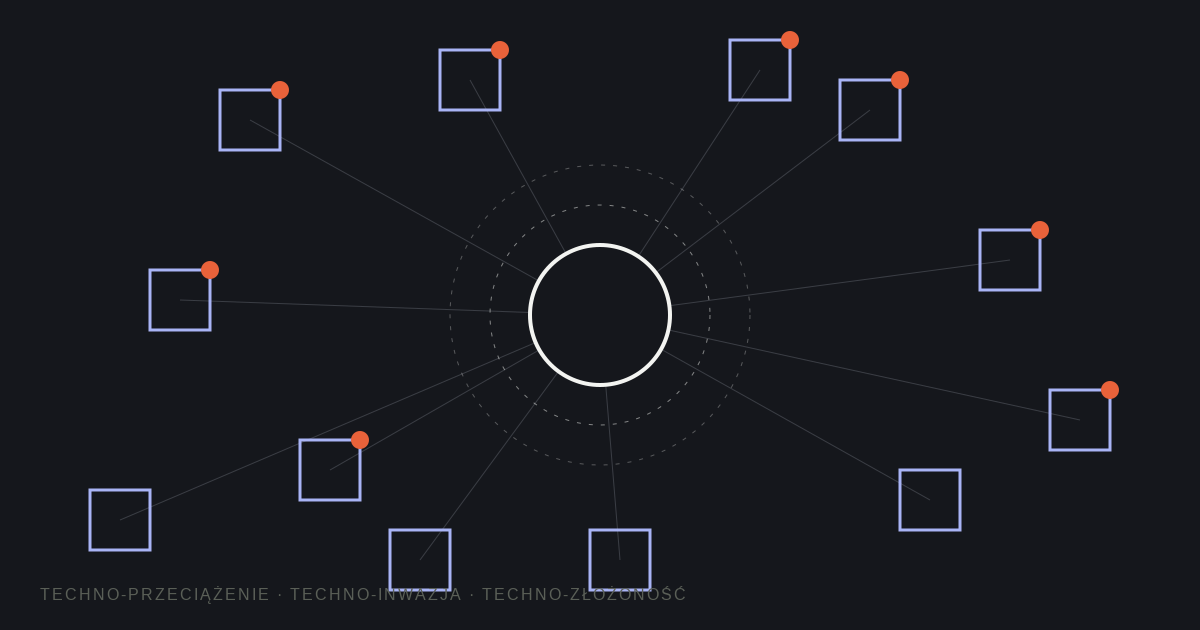
The five faces of technostress. Technostress is not a single phenomenon. Researchers distinguish five dimensions: techno-overload, techno-invasion, techno-complexity, techno-uncertainty and techno-insecurity.1 A meta-analysis of 84 studies covering 44,576 employees showed that each of these dimensions has different organizational antecedents.2 A 2026 systematic review found techno-overload and techno-invasion to be the stressors most often linked to poorer well-being.3
The scale of impact. A meta-analysis of 102 articles (113 studies, 49,955 observations) found moderate to strong links between technostress and:4
- reduced job satisfaction,
- impaired work-life balance,
- increased emotional exhaustion,
- organizational withdrawal.
The same analysis shows technostress is stronger where technology use is mandatory than where people choose their tools.4
The AI paradox: the stress side. A 2025 study in Frontiers in Psychology found AI-related technostress to be associated with symptoms of anxiety and depression.5 A second study by the same author found a subtler mechanism: AI-induced stress does not lower quality of life directly. It first shifts people toward negative emotions, and those emotions then shape quality of life.6 This explains why two people using the same AI tools can have radically different experiences: one feels empowered, the other overwhelmed.
The AI paradox: the enhancement side. A three-wave study of 600 employees found that AI efficacy, the feeling of being competent with AI tools, raises engagement and job satisfaction.7 When people feel confident working with AI, the technology becomes an ally rather than a stressor.
Part 2. What I see in practice
If your technology strategy doesn’t account for how people actually cope with it, it’s incomplete.
Part 3. What it means for leaders
- Measure what you don’t measure today. Add questions about overload and after-hours availability to pulse surveys, before engagement drops.
- Build skills, not just licences. Feeling competent with AI protects well-being. A rollout without training and time to learn is an investment in stress.
- Leave people a choice where you can. Mandated tools are more stressful than chosen ones.
Footnotes
-
Tarafdar, M. et al. (2007). The impact of technostress on role stress and productivity. Journal of Management Information Systems, 24(1). ↩
-
Kotek, M., Vranjes, I. (2025). When do employees perceive technology as stressful? A meta-analysis of work-related technostress antecedents. Information & Management, 62(8), 104203. ↩
-
Mansuroğlu, E., Smith, A. P. (2026). Technostress and employee well-being: A systematic review of empirical evidence. Computers in Human Behavior Reports, 100941. ↩
-
Nastjuk, I., Trang, S., Grummeck-Braamt, J.-V., Adam, M. T. P., Tarafdar, M. (2024). Integrating and synthesising technostress research. European Journal of Information Systems, 33(3), 361–382. ↩ ↩2
-
Lițan, D.-E. (2025). Mental health in the “era” of artificial intelligence. Frontiers in Psychology, 16, 1600013. ↩
-
Lițan, D.-E. (2025). The impact of technostress generated by artificial intelligence on the quality of life: the mediating role of positive and negative affect. Behavioral Sciences, 15(4), 552. ↩
-
Chuang, Y. T., Chiang, H. L., Lin, A. P. (2025). Insights from the Job Demands–Resources Model: AI’s dual impact on employees’ work and life well-being. International Journal of Information Management, 83, 102887. ↩