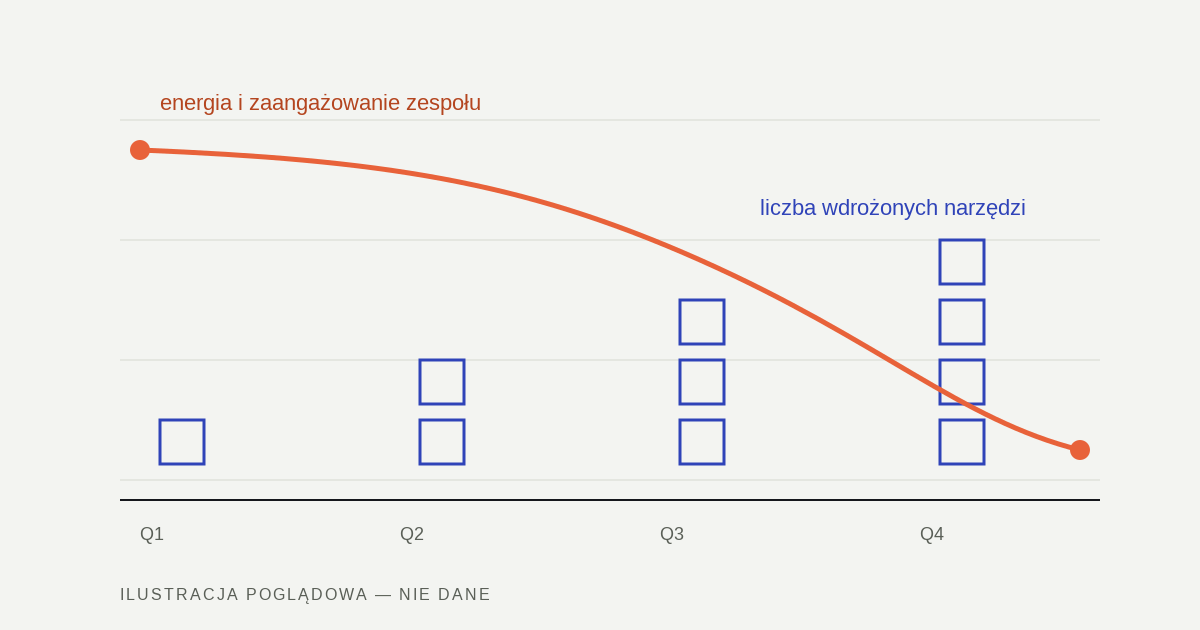
Imagine rolling out a new CRM, a collaboration platform and an AI tool for automated reporting, all in one quarter. Adoption metrics look promising. Productivity holds. Project closed.
Six months later, turnover in the department is up. The most experienced specialists are looking at other offers. Engagement in the pulse survey drops, and nobody can say why. Don’t look for the cause in the strategy. Look at what you didn’t measure.
Part 1. What the research says
Technostress is the psychological strain that comes from using technology at work. It is a documented, measurable phenomenon, and in the AI era it is reaching a new scale. Meta-analyses confirm that technology can be both a resource and a stressor.1
Researchers distinguish five dimensions of technostress:2
| Dimension | What it looks like at work |
|---|---|
| Techno-overload | The same work in the same time, but across more tools and notifications. A manager logs into five platforms before noon. |
| Techno-invasion | The line between “being available” and “always being at work” disappears. Burnout risk rises, especially in hybrid and remote work. |
| Techno-complexity | Time and energy go into operating tools instead of doing the actual work. |
| Techno-uncertainty | What you learned may be outdated tomorrow. With new AI models every few months, this stressor becomes chronic. |
| Techno-insecurity | Fear of being replaced by an algorithm. Even when unfounded, its psychological weight is real. |
A review of 102 publications found moderate to strong links between technostress and lower job satisfaction, emotional exhaustion and organizational withdrawal.1 All three feed straight into the metrics we manage every day.
Part 2. What I see in practice
Part 3. What it means for leaders
Diagnosis is only the beginning. The key question: can an organization manage technostress systemically, so that technology supports business goals rather than holding them back? 2025 research points to a paradox that changes how we think about AI rollouts. I write about it in The Hidden Cost of Digital Acceleration.
Footnotes
-
Nastjuk, I., Trang, S., Grummeck-Braamt, J.-V., Adam, M. T. P., Tarafdar, M. (2024). Integrating and synthesising technostress research. European Journal of Information Systems, 33(3), 361–382. ↩ ↩2
-
Tarafdar, M. et al. (2007). The impact of technostress on role stress and productivity. Journal of Management Information Systems, 24(1). ↩